TYPE: Chthonic god of the Underworld
ORIGIN: Egyptian
KNOWN PERIOD OF WORSHIP: Circa 3000 BCE until the end of Egyptian history circa 400 CE.
SYNONYMS: None, but many epithets are applied, reflecting the universality of his cult.
CENTER(S) OF CULT: Many throughout Egypt but chiefly at Abydos (Ibdju) in Upper Egypt and Busiris (Djedu) in the Nile delta of Lower Egypt. Other important sanctuaries are located at Biga (Senmet) in Upper Egypt south of Aswan, and at the Karnak complex of Thebes. Outside Egypt there is a major sanctuary at Philae in Greece.
ART REFERENCES: Innumerable sculptures, stone reliefs, wall paintings, and papyrus illustrations.
LITERARY SOURCES: Pyramid Texts; coffin texts including the Book of the Dead, etc.
INFORMATION: Osiris is among the most significant and widely revered deities of the Egyptian pantheon. According to the genealogy drawn up by the priests at Heliopolis, he was born at Rosetau in the necropolis (Gate of the underworld) of Memphis. His parents were Geb and Nut and he was the eldest of four siblings including his sister and consort Isis, his adversary Seth and younger sister Nephthys. Isis bore the god Horus having impregnated herself with the semen of Osiris after his death. Though Osiris is most closely linked with Isis, he is also associated with Anubis, the mortuary god of embalming and the scorpion-like mortuary god Serket.
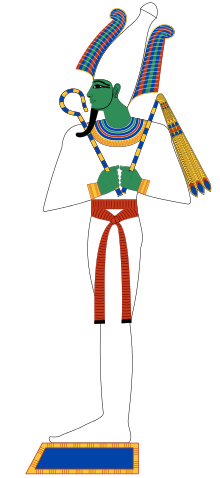
Osiris is depicted in human form but often tightly wrapped in mummy linen with only his arms free, He holds the crook and flail. His crown, the atef is distinctive, consisting of the conical white crown of Lower Egypt framed by tall plumes and rams' horns. Often his skin is colored green. Osiris was perceived as the counterpart in death of the sun god Re.
As a grain god, Osiris was worshiped in the form of a sack filled with seed that sprouted green. He is also depicted by models with articulated members that women paraded through the streets at festivals and manipulated to demonstrate the god's virility. His relationship with the Egyptian kingship was crucial. Each king was the divine embodiment of Horus in life, but became Osiris on his death.
The Osirian legend is known from pure Egyptian textual sources and from an embellished account of the Greek writer Plutarch. The latter describes how Osiris was persuaded by Seth to step into an exactly fitting sarcophagus during a drunken party. The coffin was nailed tight and thrown into the Nile. It was washed ashore at Byblos in the Lebanon where it became encased in the trunk of a growing tree. Eventually, the trunk was cut down and incorporated as a pillar in the palace of the local ruler. After years of searching, Isis found Osiris and brought his body home. She breathed life into it and impregnated herself with Osiris' semen. She bore his son Horus. Meanwhile Seth found the body and once more destroyed it by hacking it into fourteen pieces and scattering them along the Nile valley. With the exception of Osiris' penis, which Seth had thrown to a crocodile, Isis found all the pieces and buriend them at the sites of various sanctuaries. She restored the penis with a replica that subsequently became the focus of the Osirian cult. The scattering of the body was allegorized with the winnowing and scattering of grain in the fields.
The purely Egyptian account omits the incident of the sarcophagus and the discovery at Byblos. Isis is sometimes represented in the form of a hawk being impregnated by the erect phallus of the dead god. The reference to the fate of the penis with a crocodile is also omitted. In the Egyptian version, the god's phallus was buried at Memphis.